

Table of Contents
Hearing that you need a deep cleaning when you came in expecting a routine visit can catch patients off guard. Some wonder whether the recommendation is warranted. An experienced local dentist will tell you that dental cleaning vs. deep cleaning is not a question of preference or thoroughness—it reflects what the clinical examination found and what the gum tissue actually requires to return to health. The two procedures are built for different conditions, and substituting one for the other produces predictably different outcomes.
Key Takeaways
-
A routine cleaning removes plaque and tartar from tooth surfaces above and at the gumline and is appropriate for patients with healthy gum pocket depths.
-
A deep cleaning treats active gum disease by removing bacterial deposits from root surfaces below the gumline that routine instruments cannot access.
-
The recommendation for a deep cleaning is driven by specific clinical measurements—pocket depths, bone levels, and calculus location—not subjectivity.
-
Untreated gum disease progresses silently, causing permanent bone loss around the tooth roots that cannot be reversed.
-
Periodontal maintenance visits following a deep cleaning are scheduled more frequently than standard cleanings and are not interchangeable with them.
What a Routine Cleaning Is Designed to Do
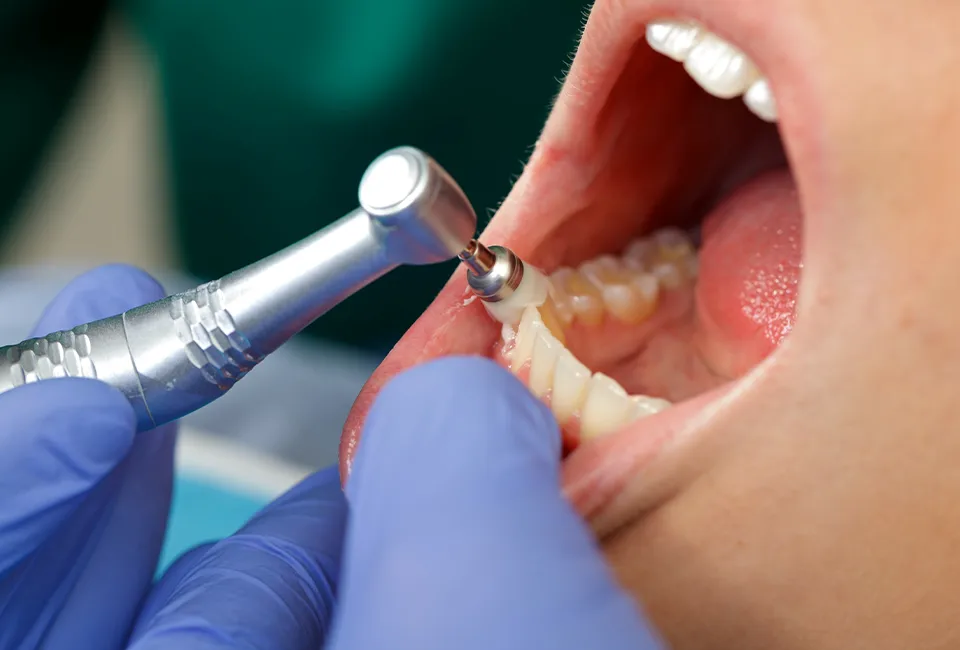
A prophylaxis—the clinical term for a routine cleaning—is a preventive procedure for patients who have achieved and are maintaining healthy gum tissue. The hygienist removes calcified and soft deposits from the visible crown surfaces of the teeth and from the gumline, polishes away surface staining, and assesses gum health using a periodontal probe.
That probing step is where the cleaning appointment and the diagnostic decision intersect. At six points around each tooth, the hygienist measures how far the probe penetrates between the tooth and the surrounding gum before it meets resistance. Depths of 1 to 3 millimeters reflect normal, healthy attachment. As depths increase beyond 3 millimeters, the clinical significance changes, and a standard cleaning becomes insufficient for what the tissue requires.
What a Deep Cleaning Is Actually Doing
Scaling and root planing—the formal name for a deep cleaning—is a therapeutic intervention for periodontitis. The procedure reaches below the gumline to clean root surfaces that have become colonized with calculus and bacterial biofilm in the space created by diseased, detached gum tissue. These surfaces are entirely inaccessible to standard cleaning instruments, which is why the two procedures cannot be used interchangeably.
The root planing component smooths the root surface after calculus removal, eliminating the rough texture that allows bacteria to recolonize efficiently and creating conditions more favorable for gum tissue reattachment. The procedure is divided into two appointments, one side of the mouth at a time, and local anesthesia keeps patients comfortable throughout.
Why Using the Wrong Procedure Produces the Wrong Result
A standard cleaning performed on a patient with active gum disease cleans what is visible and accessible but leaves the subgingival environment untouched. The bacterial communities driving bone destruction remain intact in the pockets that standard instruments cannot penetrate. The teeth may look cleaner after the appointment, but the pathological process continues below the surface.
This is not a minor distinction. The bone loss that gum disease produces is permanent. Once the alveolar bone supporting the tooth roots has resorbed, it does not regenerate on its own. Teeth that lose sufficient bone become progressively mobile and eventually unrestorable. Treating gum disease at the appropriate level when it is identified is what interrupts that process and preserves the structural integrity of the dentition.
How the Clinical Decision Is Made
The recommendation for a deep cleaning emerges from the totality of clinical findings at the examination: pocket depths at all six points per tooth, the presence and location of subgingival calculus, radiographic evidence of bone loss, the distribution of bleeding and inflammation across the mouth, and whether the gum tissue appears clinically healthy or diseased.
Borderline cases—some pockets reaching 4 millimeters without radiographic bone loss or extensive subgingival calculus—may be monitored with more frequent standard cleanings initially to see whether the tissue responds. Clear cases of established periodontitis with pocket depths of 5 millimeters or more, visible bone loss on X-rays, or significant calculus below the gumline are not appropriately managed with routine cleaning, and recommending one in that clinical picture would not serve the patient’s health.
Recovery and What Follows the Procedure
Soreness, temperature sensitivity, and gum tenderness for two to five days after a deep cleaning are normal and expected. The tissue has been thoroughly instrumented in areas it was not used to being reached, and it needs time to settle. Over-the-counter pain relief and softer food choices for a few days ease the transition.
A reassessment appointment six weeks after the second deep cleaning session re-probes the treated areas to evaluate tissue response. Pockets that have tightened into a healthy range and inflammation that has resolved indicate a good response. Patients with a favorable outcome transition into a periodontal maintenance schedule at three-to-four-month intervals—more frequent than standard cleanings and designed specifically for ongoing monitoring of previously affected sites.
The Right Cleaning Matches the Condition of the Gums
Dental cleaning vs. deep cleaning is ultimately a clinical question, not a preference one. Healthy gums that need maintenance receive a routine prophylaxis. Gums with active disease that has progressed below the gumline require scaling and root planing. The data from the examination determines which category the patient falls into, and that determination is what protects the teeth over the long term.
If you want to learn more about dental cleanings, visit our Teeth Cleaning in Camarillo page or schedule a consultation.