

Table of Contents
One tooth at a time, or all at once? Patients missing several teeth almost always face a choice between two very different paths. The dental implants vs. All-on-4 decision tends to feel overwhelming at first, mostly because both options sound similar but work very differently. The right choice depends on how many teeth are missing, the health of your jawbone, your timeline, and your budget. Knowing the basics makes the consultation feel a lot less intimidating.
Key Takeaways
- Traditional dental implants replace teeth one at a time and work best when only a few teeth are missing.
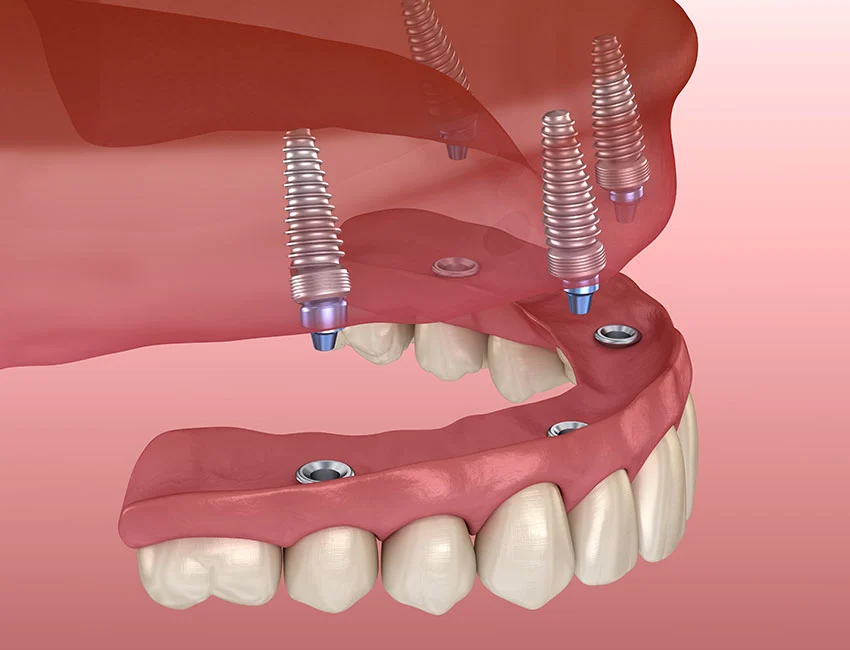
- All-on-4 uses just four implants to support a full arch of replacement teeth on the upper or lower jaw.
- Both options preserve the jawbone, which is one of the biggest advantages over traditional dentures.
- All-on-4 is often faster and more cost-effective when full-arch replacement is needed.
- A consultation with imaging is the best way to know which option fits your specific situation.
The Basics of Dental Implants vs. All-on-4
Traditional dental implants are designed to replace one tooth at a time. A titanium post is placed into the jawbone where the original root used to be. After the bone heals around the post, a custom crown is attached to complete the replacement. The result looks, feels, and functions like a natural tooth, and each implant works on its own without affecting the teeth around it.
All-on-4 takes a different approach. Instead of replacing each tooth with its own implant, only four strategically placed implants support a full arch of replacement teeth. The angled placement of the back implants takes advantage of the strongest available bone, which is why most patients qualify for the procedure even when bone loss has been an issue.
When Traditional Implants Make More Sense
Single implants are usually the right call when only one or two teeth are missing, or when several missing teeth are spread out rather than clustered together. The procedure is straightforward, predictable, and lets you keep your healthy, natural teeth in place without disturbing them.
Single implants are also the standard for patients who want the most natural feel possible. Each implant is independent, so the bite, the look, and the function of every tooth can be customized to match the rest of the smile. The trade-off is that replacing several teeth this way takes more time and more upfront cost than a full-arch solution.
When All-on-4 Is the Better Fit
All-on-4 shines when most or all of the teeth in a single arch are missing or in poor enough shape that they need to come out. Instead of placing 10 or more individual implants, the procedure uses just four to anchor a fixed bridge that replaces the entire arch. Many patients leave the office with their new teeth in place on the same day as surgery, though the final restoration is fitted later once healing is complete.
This approach also tends to work well for patients who would otherwise need a bone graft. The angled implants reach denser bone in the jaw, which often eliminates the need for separate grafting procedures. That alone can save months of healing time and a significant amount of money.
How to Decide Between Dental Implants vs. All-on-4
Several specific factors guide the conversation:
- Number of missing teeth: One or two missing teeth usually point toward single implants, while most or all of an arch tends to point toward All-on-4.
- Jawbone health: Patients with significant bone loss often qualify more easily for All-on-4 because of how the implants are angled.
- Timeline: All-on-4 typically delivers a same-day result, while single-implant treatment involves a longer staged process.
- Budget: Single implants are cost-effective for small cases, while All-on-4 is usually the more efficient option for a full arch.
- Long-term outlook: Both options are designed to last decades when properly maintained.
Frequently Asked Questions
Is All-on-4 considered permanent?
Yes, the implants themselves are designed to last a lifetime with proper care. The fixed bridge attached to them may need maintenance over the years, but it stays in your mouth full-time and is not removed at night, the way a denture is.
Can I switch from dentures to All-on-4?
Most denture wearers are good candidates for All-on-4, even when bone loss has been an issue. A consultation with 3D imaging will confirm whether the procedure is realistic for your situation.
The Right Path Starts With a Consultation
There is no one-size-fits-all answer to the dental implants vs. All-on-4 question. The right choice depends on a careful look at your teeth, your jawbone, and your goals for daily life. A good consultation will walk you through both options honestly and help you choose the one that fits your situation best, without pushing you toward a default answer.
- If you want to learn more about dental implants, visit our Dental Implants in Camarillo page to schedule a consultation.